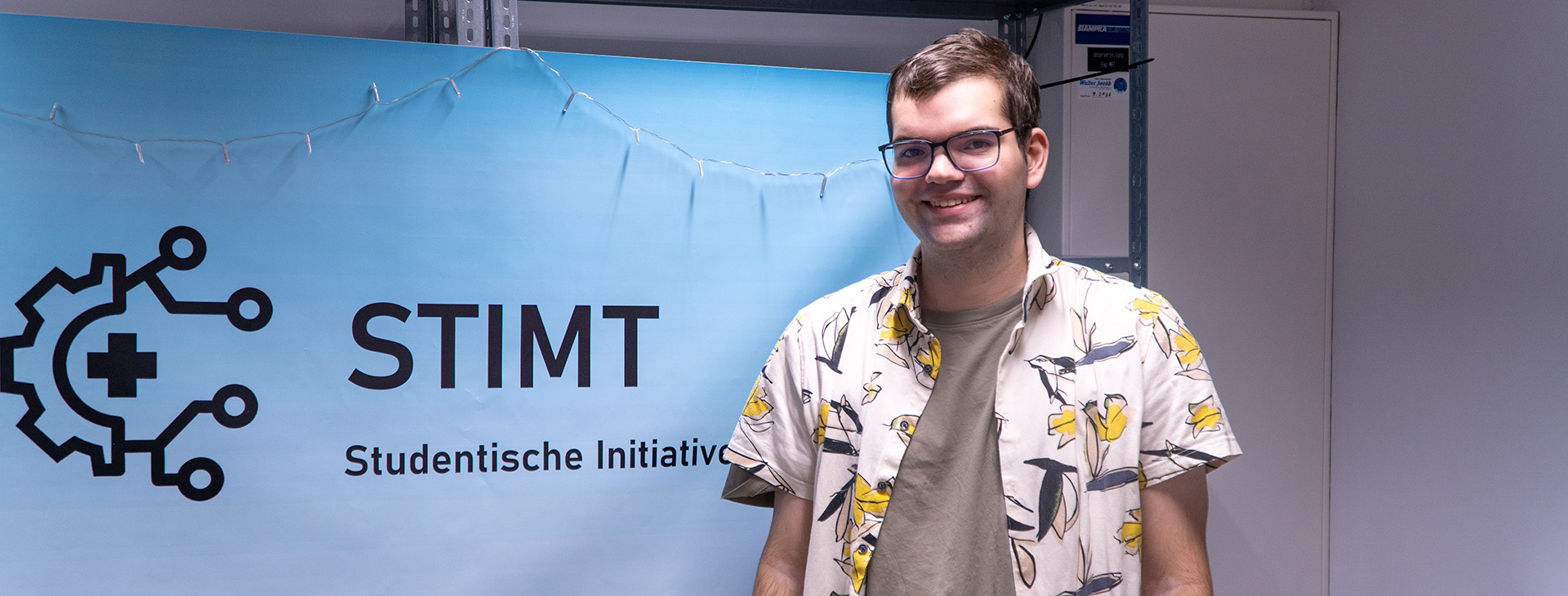

Robert Behrens and Ivan Vogt were among the pioneers who participated in the enrollment for the first Bachelor’s degree programme in Medical Technology at the Faculty of Electrical Engineering and Information Technology at the University of Magdeburg in 2014. However, they say they only realised this later on. Initially, their main motivation had been to combine their interest in electrical engineering with a subject area in which they could do “practical good for humanity”. That may sound a bit simplistic, but it’s really true, say the young scientists. Both are from Lower Saxony. However, they only met whilst studying at Otto von Guericke University in Magdeburg.
They are now developing state-of-the-art medical technology. Their own research project is called SCANATIQ. They have developed a novel coil technology for interventional magnetic resonance imaging (MRI), where doctors carry out minimally invasive procedures directly under the real-time image guidance of an MRI scanner. This year, they were awarded the Hugo Junkers Prize of Saxony-Anhalt in the category ‘Most Innovative Projects in Applied Research’ for this work.
Robert Behrens and Ivan Vogt are research associates at the STIMULATE research campus. Since its foundation in 2013, academic and industrial partners have been working here in interdisciplinary teams on solutions for 21st-century medical technology. With a smile, both describe themselves as part of STIMULATE’s ‘furniture’. After all, their links to the research campus had already been very close whilst they were still students. Young researchers from the University of Magdeburg’s own medical technology study programs are integrated into STIMULATE projects at an early stage.
Ivan Vogt worked, amongst other things, as a research assistant in the INKA research group; INKA stands for ‘Intelligent Catheters’. He subsequently moved to STIMULATE to join the MR System Engineering research team. In collaboration with the Athinoula A. Martinos Centre in Boston, this team has developed a small, compact tabletop magnetic resonance imaging (MRI) scanner. The tabletop MRI device is used in research and teaching.
Robert Behrens talks about his work as a student research assistant in the ‘Interventional Magnetic Resonance Imaging’ (iMRI) research group and on the ‘Configurable, Open-Interface, Low-Dose Computed Tomography (KIDS-CT)’ project. This led to collaboration with the RAYDIAX team, which is developing a computed tomography scanner specifically for use in operating theatres. RAYDIAX has since emerged as a spin-off from STIMULATE.
“We benefit greatly from the knowledge transfer within the STIMULATE environment, and we really appreciate the excellent conditions here,” emphasise Robert Behrens and Ivan Vogt. The state of Saxony-Anhalt is currently funding an extension to the campus, as its research infrastructure is in high demand. And STIMULATE aims to open its doors to as many promising, forward-looking ideas as possible. “Anyone with a thirst for research is recognised and supported here. That’s motivating,” says Robert Behrens.

The two scientists see their close ties with other companies as ‘mutually beneficial’. The start-up Neoscan Solutions, for example, develops and builds compact MRI systems specifically for infants and young children. Robert Behrens wrote his Master's thesis there. Neoscan is currently developing huge magnets for the world’s most powerful 14-tesla MRI scanner for use on humans. Ivan Vogt and Robert Behrens say it is something special to be able to ‘get a taste’ of the construction and development of new MRI systems right on their doorstep, and that this reaffirms their decision to stay in Magdeburg. The Wissenschaftshafen here is developing into an urban district with a medical technology centre, where inspiration for research topics arises and where, within the STIMULATE network, the rapid transfer of innovative medical technology into practical application is achieved.
“Because we engineers gain straightforward insights into day-to-day clinical practice and work in teams with medical professionals on an equal footing, we can identify where the needs lie and determine which developments in medical technology can make treatment easier for doctors and patients,” says Ivan Vogt. With his doctoral thesis, he has opened up a completely new field of research. It concerns highly sophisticated computer-assisted robotic systems that position instruments within the body with high precision during minimally invasive procedures.
In his doctoral qualification, Robert Behrens focused on sensor technology for magnetic resonance imaging, as the basic principle behind so-called MRI coils has hardly evolved over the last 20 years.
Robert Behrens and Ivan Vogt are driving forward an innovation in this field through their own research project, SCANATIQ. The word ‘scan’ is part of the name. An MRI scan produces detailed cross-sectional images of the body’s interior. This is made possible by interventional MR coils. “These are specialised receiver systems used in image-guided, minimally invasive diagnostics and therapy,” explains Robert Behrens, citing the thermal treatment of liver tumours as an example. “The better the image quality, the more precisely surgeons can position the instruments,” he says, adding that the coil is placed directly against the body to ensure good signal reception.
The innovative SCANATIQ coils will be compact, flexible and, unlike previous coils, wireless. According to the two medical engineers, this would make it easier to position the coils on the body, making things easier for both patients and doctors.
However, developing these coils to market readiness is a complex and very costly process. That is why the two scientists are delighted that they were able to win support for their idea and are now receiving EXIST funding from the German government. This funding supports the development of a viable business model.
‘... doing something practical and beneficial for humanity’ – that’s no mere slogan. Robert Behrens and Ivan Vogt are only in their early 30s and already very close to achieving this goal.